
Villa Bardini
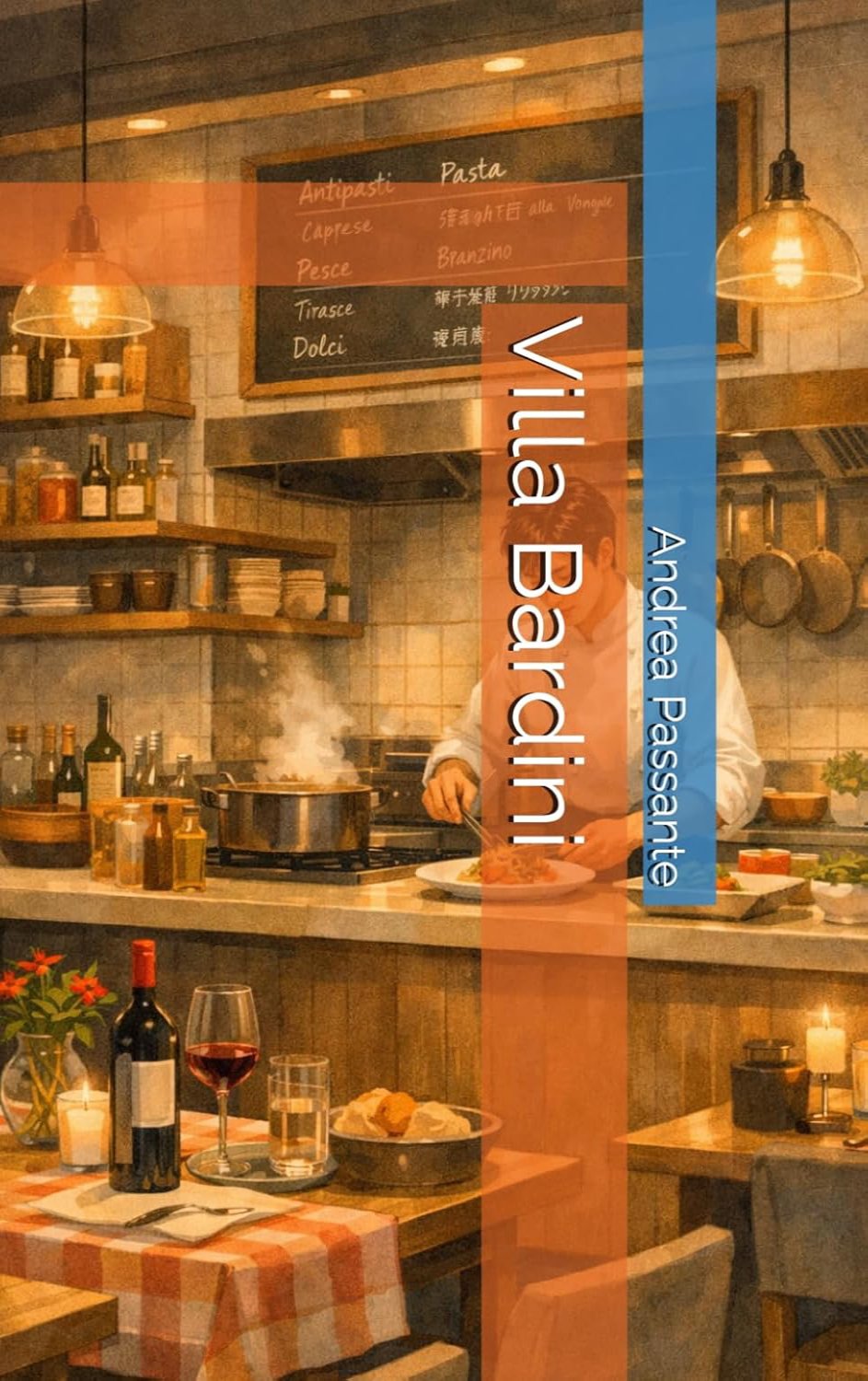
A warm, precise novel about cooking, craft, and what it means to bring something real from one place to another.
For four years, Ichirō Hayashi has cooked Italian food at a Saizeriya in Tokyo — measuring sauce from a bag, plating pasta to a photograph, timing everything to the second. The menu is reliable. The food is honest about what it is: fast, familiar, exactly what it claims to be, no more and no less. Ichirō has come to respect that honesty. But somewhere between the fryer and the pass, a quieter question has been cooking too, for longer than he'd like to admit: what does the real version actually taste like?
He never expected an answer. Then a small inheritance arrives — enough, if he is careful, for a plane ticket and a few months of rent. So Ichirō does the only thing that makes sense to him. He goes to find out.
Florence gives him nothing he expects. Not the postcard version, not the version that ends up in guidebooks, but a narrow street where the shutters go up early and the same regulars sit at the same tables on a Tuesday evening. This is where he finds I tre briganti, a trattoria that has never needed to advertise, because everyone who matters already knows where it is. Old Felice Brigante runs the kitchen the way he has for forty years — without hurry, without apology — while his daughter Sabrina moves through the dining room like she was born knowing exactly which table needs what, and when. Neither of them owes Ichirō anything. He has to earn his place at the stove, plate by plate, mistake by mistake, in a language that isn't his own.
What he learns there isn't a technique so much as a posture. Good food doesn't need to prove anything. It doesn't perform, and it doesn't apologise for being simple. It just needs to be — fully, unhesitatingly — what it is. It's a lesson that sounds obvious until you've spent four years cooking food built to resemble something else.
Ichirō carries that lesson home to Yonago where he opens Villa Bardini — his own restaurant, at last, built from everything he absorbed at Felice's stove. The tablecloths are right. The recipes are right. Even the light falls the way it did back in Tuscany, or close enough. And yet something about the place hasn't arrived yet — some difference between looking like Italy and feeling like it, one that no amount of careful sourcing seems to close on its own.
It's the small things that begin to change that. A local fish supplier's daughter, who starts showing up with deliveries that run a little longer, and a little later, than the schedule strictly requires. A neighbourhood slowly working out what to make of the restaurant in its midst. A kitchen where a Japanese chef, two Italian servers, and a growing handful of regulars are all, in their own ways, still translating — not just a menu, but a place, and what it might mean to actually belong to it.
Villa Bardini is a novel about apprenticeship and homecoming, about the difference between a recipe and the hands that make it, and about what survives — and what has to be rebuilt from scratch — when something true crosses the distance between two countries.
Reading level
| Dimension | Assessment |
|---|---|
| Sentence structure | A2+/B1 |
| Core vocabulary | A2+/B1 |
| Idiom & colloquial English | B1 |
| Figurative & abstract language | B1/B1+ |
| Cultural references | B1/B2 |
| Irony & humour | B1 |
| Subtext & inference | B1/B2 |
| Supported classroom use | A2+ |
| Independent reading | B1 |
Why two levels? In the classroom, teacher guidance, discussion, glossaries and chapter materials provide support for food-related vocabulary, cultural references, figurative language and the novel's themes of authenticity and belonging. Independent readers need to handle those elements with less scaffolding, so a higher reading level is recommended.